Home/vzn staff presentation
Staff Training — The Exam Experience
1 / 11
Internal Staff Training

The VZN exam.
Here's what actually happens.

This isn't a cheaper version of an eye exam. It's a more thorough, more focused exam — delivered efficiently, right here at your trusted provider.

1Specialist, Full Visit
Clinical-GradeLatest Equipment
0Extra Trips
1Licensed OD Reviews All
Click any stage to walk through it in detail →
Traditional Office Visit
What most patients have already experienced
VZN Telehealth Exam
What we provide at this office
1
Arrive & Check In
Multiple staff, story repeated at every step
Handoffs
2
Pre-Testing by a Tech
Rushed, standard equipment, limited imaging
Limited
3
Doctor Performs Refraction
Most of visit spent on data collection, not eye health
Data-Heavy
4
Brief Health Discussion
What's left after refraction — typically a few minutes
Rushed
5
Handed Off to Optical
New person, no context, starts over
Fragmented
1
One Specialist Greets You
Stays with you the entire visit — no handoffs
Continuous
2
Full Work-Up: Latest Technology
Clinical-grade instruments, comprehensive imaging
Comprehensive
3
Specialist Handles Refraction
OD receives all data before entering — free to focus on health
Doctor-Ready
4
OD: Full Focus on Eye Health
No distractions, no data to collect — only the patient
Focused
5
Same Specialist to Optical
No handoff — continuity through frame selection and order
Seamless
Traditional
Arrive & Check In
Your story gets told — over and over
The patient checks in at the front desk, explains why they're here, then repeats that story to the tech, and again when the doctor finally arrives. Every handoff means starting over.
!
Reason for visit repeated multiple times
Front desk → tech → doctor. Same story, three different people
!
Multiple staff, no continuity
Each person has partial context — nobody owns the full experience
VZN
One Specialist — Start to Finish
Your story is told once. It stays that way.
The VZN specialist greets the patient at check-in and stays with them through the entire visit — instruments, refraction, OD consultation, and optical. One person, full context, no handoffs.
One specialist throughout the entire visit
The same person who heard your concerns is with you every step — nothing gets lost
Reason for visit captured once — in full
Your concerns, symptoms, and history carry through to the OD before the conversation even begins
Traditional
Pre-Testing by a Tech
Standard instruments, standard depth
A tech runs the patient through a standard pre-test suite — often while managing multiple patients. They do what they can in the time they have, then pass the patient along. The doctor receives what was captured.
!
Tech is managing several patients at once
Less focused time, less consistency — this isn't their only room
!
Standard equipment suite
The OD receives whatever the instruments and time allowed — not a complete clinical picture
VZN
Full Work-Up: Latest Clinical Technology
The OD receives a complete data set — before saying hello
The VZN specialist isn't rushing to another room. Their only job right now is this patient. They run the full suite of clinical-grade instruments, capturing the most complete picture of eye health possible — so the OD enters with everything.
Dedicated specialist — one patient, full attention
Not splitting time across rooms; entirely focused on this visit
State-of-the-art instruments throughout
VX650, VX40, OCT retinal imaging, slit lamp — selected for clinical depth, not convenience
OCT retinal imaging — recommended as standard
Available and encouraged at every exam so the OD has the most complete view of eye health
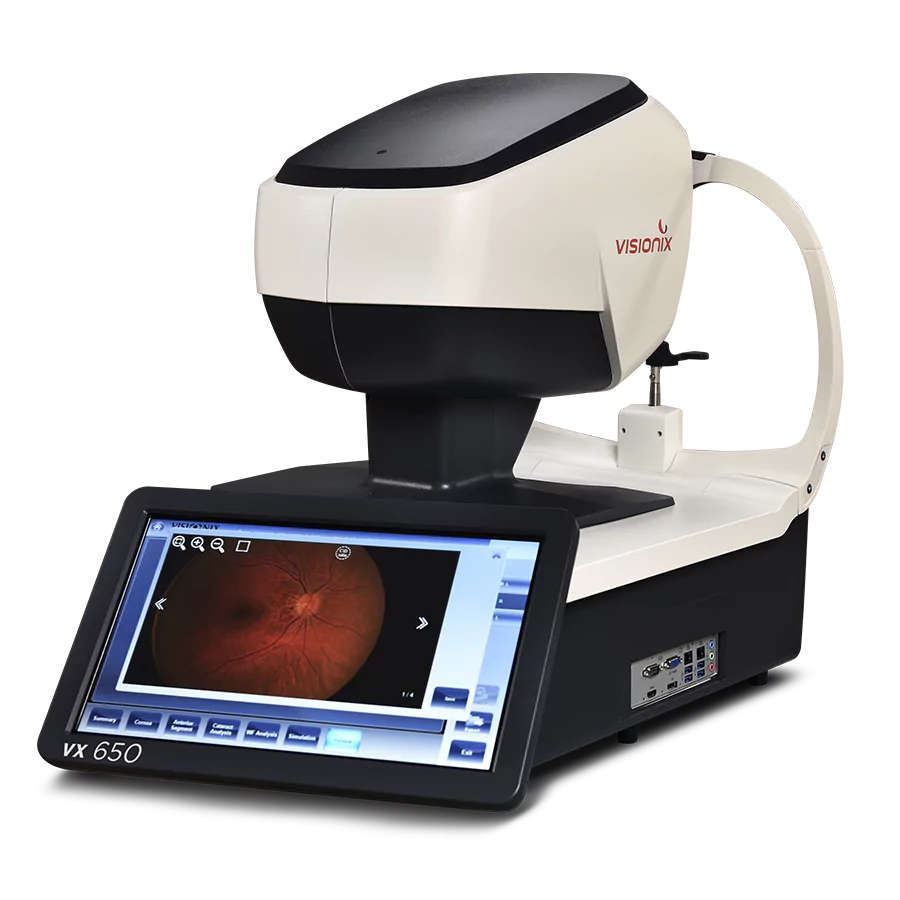
VX650
VX650 · VX40 · OCT · Slit Lamp MW50D
See the full equipment breakdown
Equipment slide →
Traditional
Doctor Performs the Refraction
Clinical time spent on data collection
In a traditional exam, the doctor personally performs the subjective refraction. "Better 1 or 2?" takes up most of the time the patient actually has with the doctor — time that could otherwise be spent discussing eye health.
!
Doctor's time consumed by refraction
The exam becomes a data collection exercise — eye health discussion is what's left over
!
Doctor is still gathering, not reviewing
They are building the picture of your eye health in real time, rather than arriving with it already
VZN
Specialist Handles Refraction & Slit Lamp
The OD arrives ready — not still collecting
The VZN specialist performs the full subjective refraction and slit lamp examination — with the slit lamp video-recorded for the OD to review. By the time the doctor enters, the data work is done. Their only job is the patient.
Refraction handled by specialist, not the OD
The doctor's clinical time is reserved entirely for reviewing findings and discussing eye health
Slit lamp video-recorded (MW50D)
OD reviews actual footage, not a text summary — a more complete clinical record
Old vs. new Rx comparison ready before OD enters
Changes flagged in advance — the doctor discusses, rather than discovers
Traditional
The Doctor Visit
Prescription first. Health second — if there's time.
By the time the doctor has completed the refraction, most of the appointment window is gone. A quick health conversation follows — but the doctor is still running the office, answering staff, managing their schedule. Their attention is split.
!
Most of visit spent on prescription, not health
Eye health discussion is compressed into whatever time remains after refraction
!
Doctor managing a full, busy practice
No matter how good the doctor, they're not focused solely on this patient
VZN
The OD's Only Job: This Patient
Ready when the patient is. Nothing else on their plate.
The VZN optometrist has reviewed all imaging, refraction data, history, and slit lamp video before the conversation begins. They're available as soon as the patient is ready. No office to manage. No waiting. Their full clinical attention goes to one thing — the patient's eye health.
Arrives with everything already reviewed
No data collection during the visit — only clinical discussion and education
No office distractions — zero
That level of focused clinical attention is genuinely hard to replicate in a traditional setting
Reviews imaging with the patient — live
Discusses changes, symptoms, and findings in depth. The specialist is still right there with the patient throughout.
Traditional
Handed Off to Optical
A new person. Start over.
The exam ends and the patient is sent to optical — where a different person, with no context from the exam, helps them pick glasses. Whatever was discussed with the doctor doesn't carry over. The optical experience is disconnected from the clinical one.
!
New staff member at optical — no continuity
They don't know what the doctor found, what the patient needs, or what was discussed
!
Clinical findings don't inform the optical experience
The connection between the exam and the glasses recommendation is broken
VZN
Same Specialist — Through to Optical
No handoff. The whole visit stays connected.
The specialist who ran every instrument, sat through the OD consultation, and knows exactly what was found — is also the person who helps the patient select their glasses. That continuity produces a more personal, more informed optical experience. And it all happens right here, at their trusted provider — no extra trip needed.
No handoff — the specialist never leaves
Full context from exam to optical: lifestyle, prescription changes, what the OD discussed
Personalized glasses recommendation
The person helping you choose frames actually knows your eyes — not just your prescription number
Eye care at their trusted dental provider
Convenient, familiar, no separate trip — vision care woven into a place they already trust
The Technology Stack
What's in the room — and what each one does.
Selected to capture more data, more accurately, so the OD has a complete picture before the clinical conversation starts.
Visionix VX650
Visionix VX650
Refraction & Corneal Analysis Station
Combines autorefraction, topography, pachymetry, and pupillometry in one step. Captures objective data that would require multiple instruments in a typical office.
TopographyAutorefractionPachymetry
Product page ↗
Visionix VX40
Visionix VX40
Wavefront Auto Lensometer
Objectively measures the patient's current lenses using wavefront analysis. Produces a precise Rx baseline — not a manual read. The starting point for old vs. new comparison.
WavefrontObjective RxAutomated
Product page ↗
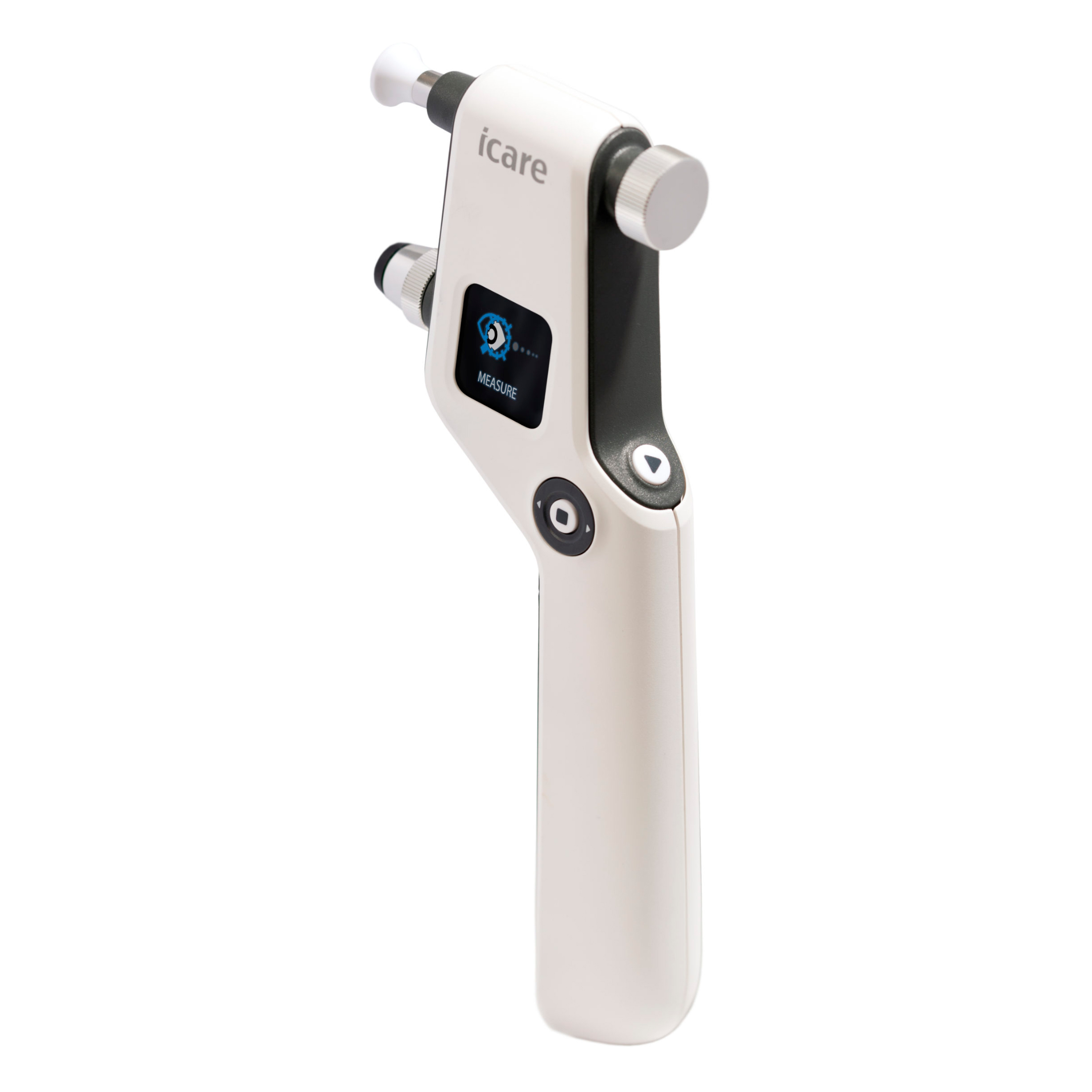
iCare IC100
iCare IC100
Handheld Tonometer — No Air Puff
Measures eye pressure (IOP) with a gentle probe tip — no air blast. Accurate, comfortable, and fast. Important for glaucoma screening. Patients who've dreaded the air puff are consistently relieved.
No Air PuffIOPGlaucoma Screening
🩻
OCT Retinal Imaging
Deep Retinal Layer Scanning
Cross-sectional imaging of the retina at a microscopic level. Standard in specialty practices — included in every VZN exam. Rarely available as part of a routine general optometry visit.
Retinal LayersDisease DetectionLongitudinal
💡
Slit Lamp MW50D
Video Slit Lamp
The slit lamp exam is video-captured — not just summarized in typed notes. The OD reviews actual footage of the anterior and posterior eye. A materially more complete clinical record than typed observations.
Video DocumentedRemote OD Review
📐
Visionix VX25
Digital Chart + EyeRefract System
Space-efficient digital vision chart with guided subjective refraction. Consistent, calibrated, and connected to the full workflow. Replaces traditional projection charts with a reproducible digital process.
Digital ChartConnected Workflow
The Analogy That Works Every Time
Patients already trust this model.
They experience it at every dental visit.
When patients hear "telehealth," they imagine less care. This analogy reframes it in terms of something familiar — before they've had a chance to assume the worst.
🦷
At the Dentist
A model patients already trust
  • Hygienist takes x-rays and does the cleaning
  • Hygienist records all measurements and findings
  • Dentist reviews everything the hygienist collected
  • Dentist focuses entirely on your oral health
=
👁️
With VZN
Same model — applied to eye care
  • VZN specialist runs all instruments and imaging
  • Specialist completes refraction and slit lamp exam
  • Remote OD reviews all data and imaging
  • OD focuses entirely on the patient's eye health
"
Think of it like your dental visit. Your hygienist does the full workup — x-rays, cleaning, measurements — and then the dentist comes in to review your health. Same idea here. The VZN specialist collects all the data, and the optometrist does the clinical review.
Use this early in the conversation, before a patient has time to form a negative assumption about telehealth. It reframes the experience as familiar — not foreign.
Handling Pushback
When a patient raises a concern, here's what to say.
Every objection comes from an assumption — not experience. These responses work. Use them as-is.
Patient Says
"This sounds like a lesser version of a real eye exam."
You Say
"It's actually more comprehensive — our technology captures more detail than most traditional exams, and a licensed optometrist reviews everything. Most patients are surprised by how thorough it is."
Patient Says
"I'd rather just go to an eye doctor's office."
You Say
"Totally understand. You'd still have a licensed optometrist reviewing your results — just without the separate trip and waiting room. Most people who try it say they'd never go back."
Patient Says
"Is there a real doctor actually looking at my results?"
You Say
"Yes — a licensed optometrist reviews and approves everything. They have more time to focus on your eye health than in a typical visit, because all the data is already prepared for them before the conversation starts."
Patient Says
"I don't really trust telehealth for something like this."
You Say
"That's a fair reaction — think of it like your dental visit. Your hygienist does the full workup, and the dentist reviews your health. Same here. The VZN specialist collects the data, and the doctor does the clinical review."
Quick Phrases — Use These Anytime
While you're here, we can check your vision — no extra trip.
It's like how your hygienist does the workup and your dentist reviews your health.
A real optometrist reviews everything and signs off on your prescription.
Most patients say it's the best eye exam they've ever had.
You're not getting less of an exam — you're getting a more thorough one, delivered more efficiently.
The doctor's entire focus is on your eye health — not on collecting data points.
What to Believe — And Why
Four things to internalize before talking to any patient.
You don't need to memorize scripts. You need to believe this first. The confidence follows naturally.
01
The Doctor Is More Focused, Not Less
In telehealth, the optometrist's only job is reviewing your patient's results and talking to them about their eye health. Nothing else on their plate — no office to manage, no waiting room, no distractions. That level of focused clinical attention is genuinely hard to replicate in a busy traditional setting.
When a patient worries the doctor isn't really there — they are. More focused than ever.
02
Advanced Technology Captures More Details
Traditional exams rely heavily on what a doctor can observe in the moment — limited by time and attention. Our specialist uses advanced clinical-grade technology to collect images, data, and measurements that give the doctor a more complete picture of your patient's eye health than most in-person visits provide.
More data, better equipment, more complete picture — before the doctor even speaks to the patient.
03
This Is the Superior, Clinical-Grade Option
The most common patient assumption: telehealth = cheaper = lower quality. It's the opposite. This is a thorough, documented, technology-driven exam reviewed by a licensed optometrist. Patients aren't trading down — they're getting a more comprehensive exam delivered more efficiently.
They're not settling. They're upgrading — and most won't realize it until after.
04
Most Patients Say It's the Best Exam They've Had
Because the technology handles the imaging quickly and precisely, the doctor has more time for what actually matters — talking through your patient's eye health, answering questions, and making sure they leave confident. When patients experience it, their hesitation disappears.
The hesitation is always about the unknown. After the exam, it's gone.